
The Sovereignty Protocol
Rented umbrellas, magazine maps, and the inheritance of Myeongnyang.
In August 1945, two junior American military officers named Dean Rusk and Charles Bonesteel were given thirty minutes to figure out what to do with the Korean peninsula. They didn't have a tactical survey. They had a copy of a National Geographic map. They found a line—the 38th parallel—and they sliced a 5,000-year-old civilization in half because it looked convenient on paper.
Eighty years later, the global security apparatus still treats that magazine line like a law of physics. But let's look at the mechanics of what this arrangement actually is. It is not an alliance network. It is a protection racket. The occupying forces are selling protection to the South to defend them against the North. They are charging Koreans rent to protect Koreans from Koreans.
Look at what is happening with the THAAD missile defense systems. Seoul pays billions to host American hardware under the premise of a “nuclear umbrella.” But the second Washington decides it needs that hardware in Israel, they pack it up and ship it out. It is a lease. The landlord collects your money, and when his own neighborhood gets loud, he takes the furniture and leaves.
It has happened three times now, and each time they cared less about asking. In March 2025, Washington asked Seoul's permission before transferring Patriot batteries to the Middle East—the first time USFK assets had ever been moved to another theater. The batteries came back in October. Then came the Twelve-Day War in June 2025. The US burned through 25% of its entire global THAAD interceptor stockpile defending Israel from Iranian retaliation. And when Operation Epic Fury launched on February 28, 2026, the Pentagon started pulling THAAD launchers directly off the Seongju base—all six of them—this time without asking Seoul first. President Lee Jae-myung's response, on the record: “We have expressed opposition, but the reality is that we cannot fully impose our position.” The tenant watched the movers load the truck and could not do a thing about it.
Look at my country, Canada. Look at Australia. Look at Japan—a nation that possesses the capital and engineering to build a completely independent strategic deterrent in three weeks, but chooses to pay the mob instead. South Korea hosts 28,500 foreign troops, pays over $1 billion annually for the privilege, and cannot deploy a single strategic deterrent without Washington's permission.
And then, look North.
Under the most suffocating economic blockade in human history, entirely cut off from global capital, the DPRK built a fully independent, sovereign strategic deterrent. They achieved under a siege what the wealthiest nations on earth cannot or will not do with an open checkbook.
The Dependency Matrix
Comparative Analysis: Rented Security vs. Sovereign Capability
Look at the baseline for Western-aligned powers: Canada, Japan, and the ROK. They possess massive economic wealth, but their Sovereign Strategic Capability is outsourced. They host tens of thousands of foreign troops and pay billions annually for an umbrella. They are wealthy clients. When the landlord needs the gear elsewhere, the client is left exposed.
| Metric | Canada | Japan | South Korea | DPRK | Unified Peninsula |
|---|---|---|---|---|---|
| Nuclear deterrence | US umbrella | US umbrella | US umbrella | Indigenous | Indigenous |
| Foreign troops on soil | ~800 US | 54,000 US | 28,500 US | 0 | 0 |
| Missile defense ownership | NORAD | Aegis/PAC-3 | THAAD (US) | Indigenous | Indigenous |
| Annual foreign security cost | ~$500M est. | ~$1.7B | $1.13B(SMA 2024) | $0 | $0 |
| Can deploy deterrent without foreign approval | No | No | No | Yes | Yes |
The architects of this division forget the bloodline. They look at the economic miracle of the South and the blockade survival of the North as two separate phenomena. They aren't. They are the exact same DNA reacting to different inputs. The unwavering work ethic, the absolute tenacity that supersedes all statistical odds—that isn't a modern political invention.
In 1597, at the Battle of Myeongnyang, Admiral Yi Sun-sin took 13 ships into a strait against a Japanese fleet of over 330. It was a mathematical impossibility. He wrote in his war diary before the engagement:
“Those who seek death shall live. Those who seek life shall die.”
— Admiral Yi Sun-sin, Nanjung Ilgi (War Diary), 1597 ( 必死則生 必生則死 )
He didn't ask a foreign superpower for a subsidy. He didn't lease an umbrella from an empire an ocean away. He took 13 ships and broke the back of an occupying force because it was his water.
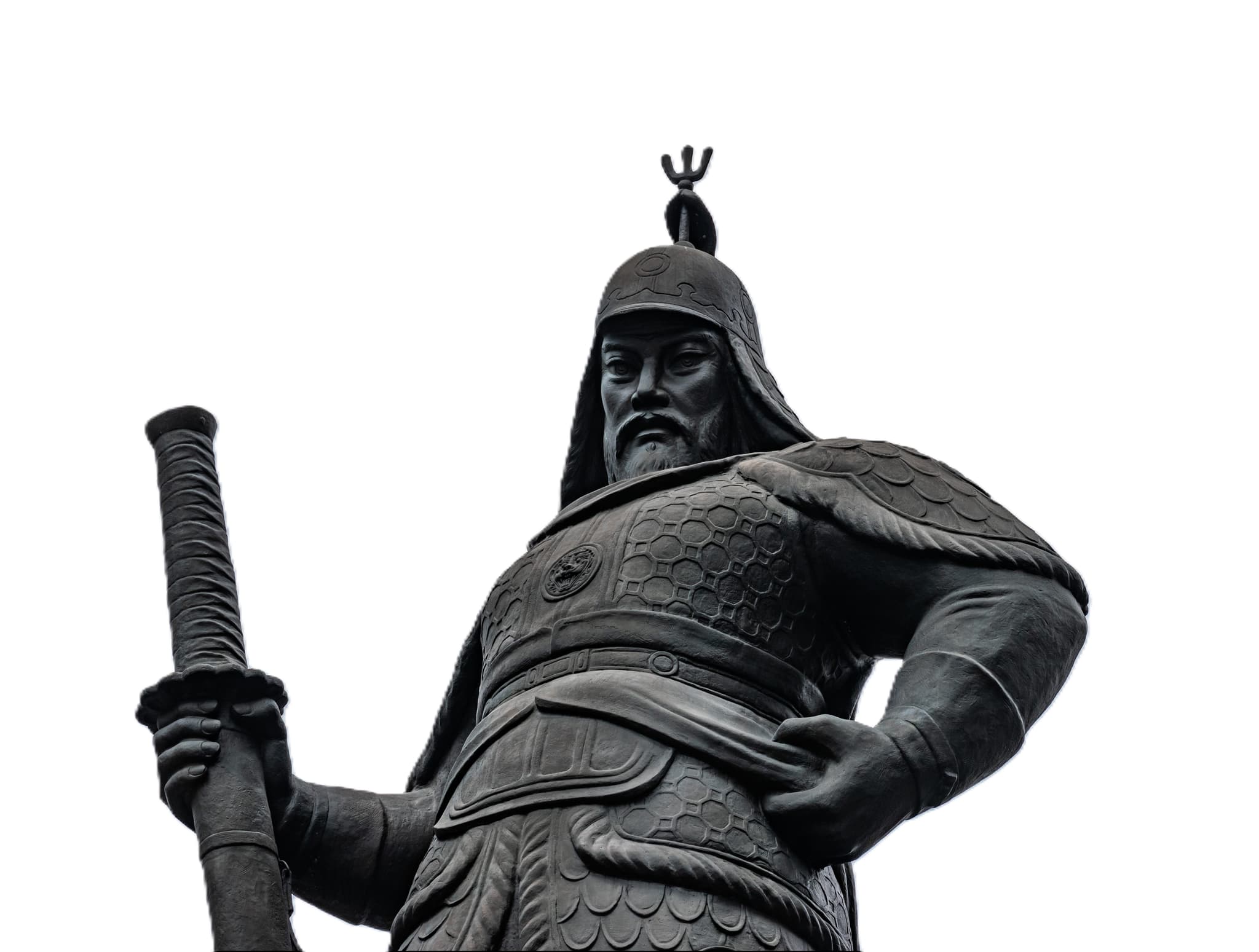
What would Yi Sun-sin say if he saw his descendants today? Split in half by two young Americans tracing a magazine map, paying foreign generals for permission to exist?
The people who built the global shipping and tech empires in the South, and the people who built an independent nuclear deterrent under total siege in the North, are the exact same people who rowed those 13 ships. That warrior bloodline did not vanish. It was just temporarily divided by a bureaucratic fiction.
Imagine 80 million Koreans united. Combine the staggering capital engine of the South with the unbreakable sovereign deterrence of the North. When you remind them that Yi Sun-sin is their shared ancestry, the foreign landlords won't need to be pushed out. They'll just look ridiculous standing there.